Playing with sounds: what fifteen studies reveal about autism and phonological awareness
Three Brazilian researchers gathered fifteen studies on how the ability to play with the sounds of words is measured in autistic children. Here is what they found, what they cannot claim yet and what to take home.
“Ba-na-na.” “Cat rhymes with hat.” “What starts with the same sound as mommy?” Long before they open a book, children love chopping words into pieces, hunting for rhymes and spotting the first sound. That game has a name, phonological awareness, and it is one of the foundations of reading. A review published in 2026 in Brazil’s Revista Psicopedagogia set out to learn which tools are used to measure it in autistic children and what those tools show. Its conclusion: the picture depends heavily on the instrument chosen, and measures designed for the full diversity of the spectrum are still missing.
What they studied
This is a systematic review with meta-analysis: a study that methodically tracks down everything published on a question and pools the numbers from several studies into a combined result. It was written by Alessandra Cristina Vieira de Araújo, Carla Alexandra da Silva Moita Minervino and Filomena Maria Gonçalves da Silva Cordeiro Moita, from the Federal Universities of Paraíba and Rio Grande do Norte and the State University of Paraíba (Brazil). They followed Cochrane methods and the PRISMA guidelines, and registered their protocol in advance with the international PROSPERO registry.
In mid-2024 they searched four databases (ERIC, Google Scholar, SciELO and Periódicos CAPES) for research published between 2014 and 2024, in English, Spanish or Portuguese, that measured this skill in autistic children under eight and, where possible, compared them with neurotypical peers. Out of 95 records, after removing 27 and screening the remaining 68, 15 studies met the criteria: twelve in English and three in Portuguese. Six came from the United States, four from Australia, three from Brazil, one from Canada and one from Israel. A second reviewer checked every step, and quality was rated with established scales (Newcastle-Ottawa and GRADE).
What they found
The first thing the review revealed was how varied the instruments are. The most common were two American early literacy batteries for preschoolers, the PALS-PreK and the TOPEL; the Brazilian studies used the CONFIAS, adapted by the research teams for autistic children. The skills measured included rhyme, alliteration (words that start the same way), recognizing syllables, taking a chunk out of a word and blending separate syllables.
Using the studies that had a comparison group, the authors ran three meta-analyses:
- Everything together, as an exploration. Pooling eight studies, the autistic group scored lower at the first measurement (p = 0.005), but the difference did not hold at the second, possibly because of one study that compared against other autistic children. Results varied enormously (I² = 89%), so the size of the effect is not precise.
- The TOPEL, the main analysis. Across five studies, the gap with neurotypical peers was statistically significant (p = 0.0001; combined effect of −1.18). Even the studies close to the “no difference” line showed somewhat lower averages. Still, heterogeneity remained high (I² = 77%): the spectrum spans very different profiles, and countries, cultures and school systems differ too.
- The NEPSY-II, as a complement. Only two studies used this general neuropsychological battery, and there the difference was not significant (p = 0.38; effect of −0.24). In one of them, with older school-age children, both groups scored similarly. The authors caution that this does not prove there is no effect: the data were limited.
The underlying message is that, depending on what is measured and how, the same skill can look like something still developing or like a strength. In the discussion, the article also draws on other research. Some autistic children do not speak, others start later, and others have no speech delay but find reading comprehension challenging; one study of 81 autistic readers identified four distinct profiles. Another, with 18 autistic schoolchildren, found that their ability to play with sounds was linked more to perceptual reasoning (solving problems without words) than to verbal abilities. The authors also cite modest gains when this skill is practiced specifically throughout the school year.
What we still don’t know
The article lists its own limitations:
- There were few studies, with small samples; the authors call for larger research.
- Two of the three meta-analyses showed variability above 50%, partly because two studies recorded their data differently.
- None of the studies reported results skill by skill (rhyme, syllables…), so only an overall score could be compared, with no way of knowing which specific part is harder.
- The PALS-PreK, one of the most widely used instruments, could not be included in the calculation because those studies lacked a comparison group. Brazilian studies, and adapted and translated tools, are also scarce.
- For the NEPSY-II there were no preschool data, so a study with older children had to be included.
- No one has yet checked whether what is learned lasts and carries over into daily life; a Swedish study from 1995 found that gains made with a computer program faded over time.
- Under GRADE, observational studies start at low certainty; the team chose not to downgrade further, even though some studies had no comparison group.
What we can take home
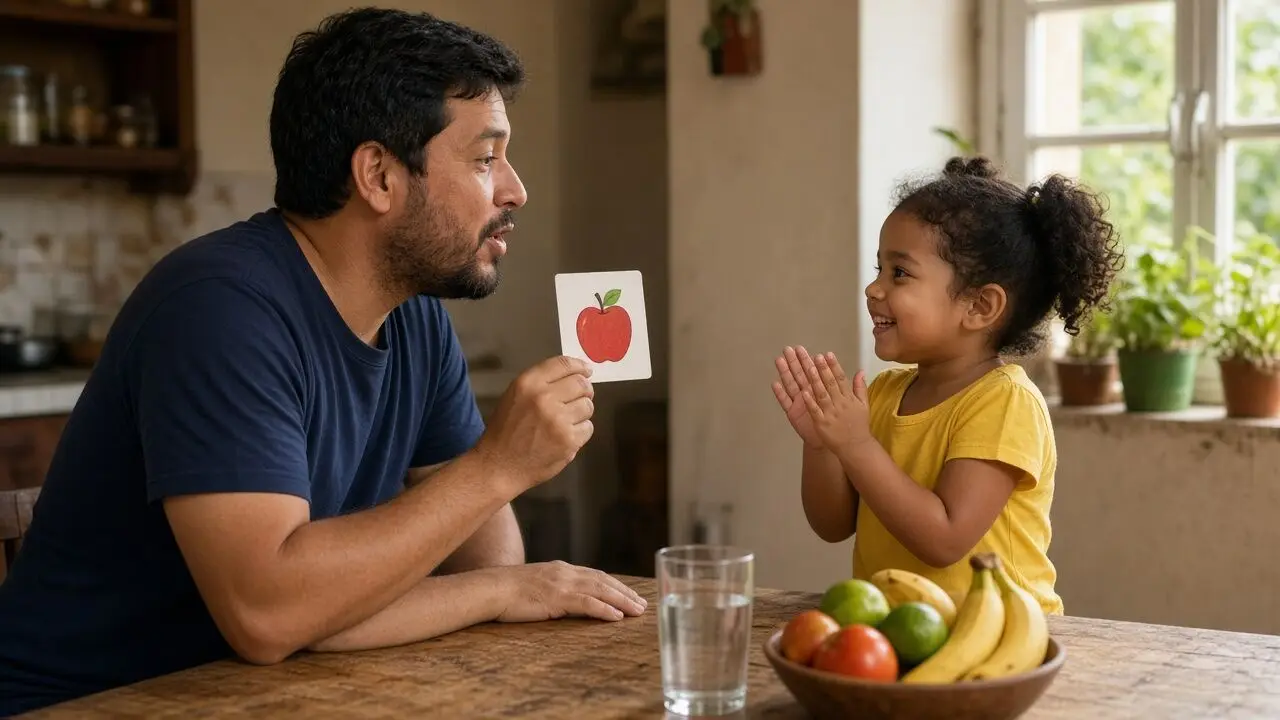
- Sounds inside the routine. No worksheets needed: rhymes while putting on shoes, one clap for each syllable of the fruit you are about to eat (“ba-na-na”), or guessing which kitchen object starts with “m.”
- Lean on what can be seen. If, for some autistic children, this skill relies on perceptual reasoning, adding pictures, objects or gestures helps: an apple card while you say “ap-ple,” a pebble for each syllable.
- Little and often, and never judge by a single score. New skills need repetition to stick, and one result does not define your child: depending on the measure, the same skill looks different. Notice what they already do and start from there.
The next step: meet your child at their developmental stage with TAEO | EdTech
This review leaves two ideas that guide our approach. Playing with the sounds of words is an early foundation of reading and, according to the research it gathers, it grows stronger with steady practice. And the same skill can look more or less mastered depending on the instrument used, while the spectrum covers a wide range of profiles. That is why TAEO | EdTech does not start from a label or from age.
The Skills and Competencies Profile covers all eight aspects of neurodevelopment, including communication and language, and shows what your child already does. From there, the platform lays out short everyday activities, with illustrations and clear steps, matched to their real developmental level. The activities are the same for every family; what changes is the path. No app can promise to raise a score on these measures; what we can offer is daily guidance so that sound games become part of family life.
At the TAEO Psychoeducational Organization we have poured more than sixteen years of experience into TAEO | EdTech so that every family has clear activities and a human team that guides them step by step.
To celebrate our official launch in December 2026, you can request an invitation to the free trial using the form below.