Support from the cradle: the Columbia study following babies, genes and families
A New York team designed a study that follows 180 babies from birth to age two to understand how developmental paths begin and how families experience genetic information. Here is how it works, the figures behind it and what it teaches us.
Many parents of autistic people tell a similar story: they noticed something different very early, in the way their baby looked, played or settled, and still years went by before they got an answer. During that wait the baby kept growing and the family moved forward without guidance. A team at Columbia University in New York designed a study to shorten that time and, along the way, to ask a question that is almost never raised: how do the people raising a newborn experience receiving genetic information about them?
What they studied
This article does not present results yet. It is a protocol: the detailed plan of an ongoing study, published so other teams can see how it is done. The PROGRESS center, funded by the U.S. National Institutes of Health, began in September 2022 and will run for five to seven years.
Most babies come from GUARDIAN, a program that sequences the whole genome of newborns in hospitals in Manhattan, Brooklyn and Queens. They are placed in three groups:
- 30 babies with a new genetic variant, not inherited from their parents, that greatly increases the likelihood of later receiving an autism diagnosis.
- 30 babies with an autistic older brother or sister, without that variant.
- 120 babies with no identified genetic or family likelihood, chosen to resemble the others in sex, background, home language and neighborhood.
In total, 180 full-term babies from families who can take part in English or Spanish. At 3 or 4, 6, 9, 12 and 15 months they visit a lab designed for them, sitting on their mother’s or father’s lap. There the team records brain electrical activity with a cap of 128 sponge sensors soaked in saline and baby shampoo, heart rhythm, where the baby looks and how their hearing responds. A stretch of free play with their caregiver, 5 to 10 minutes long, is also filmed, and a developmental scale covers fine and gross motor skills, visual perception and language. Questionnaires on sleep, temperament and digestion complete the picture.
At 18 and 24 months families fill in early screening questionnaires. At age two, a full diagnostic assessment is offered to every baby in the first two groups and to those in the third whose questionnaires suggest it.
The other half of the project looks at the adults. Surveys and interviews measure anxiety, mood, hope, bonding with the baby, parenting confidence, the couple’s relationship and family decisions, at the start, about a year later and after the diagnosis is known. The protocol also includes a family navigator, milestone-based guides and multilingual videos that explain, step by step, how to access early support services. The protocol was developed with the autism community and a six-member board of scientists, providers, caregivers and autistic self-advocates.
What they found
Nothing of its own yet: data collection is still under way, and once it ends the de-identified data will be shared through the U.S. National Institute of Mental Health data archive. What the article does gather are the figures behind the project:
- About 1 in 31 children is estimated to be autistic, with roughly 3 to 4 boys for every girl.
- The American Academy of Pediatrics recommends watching for signs between 18 and 24 months. Even so, most children in the United States are diagnosed after age 3, at an average of 4 to 5.
- Rare genetic variants contribute to autism in about 15 % to 20 % of cases. More than 200 associated genes are known and, according to statistical models, hundreds remain to be identified.
- A baby with an autistic older sibling is at least ten times more likely to receive the diagnosis than the general population.
- Within the same family, the same genetic variant can lead to different developmental outcomes.
- Babies with a genetic or family likelihood, even those who are never diagnosed, often show early differences in social attention, brain connectivity and sensory processing.
With the planned sample, and assuming one in five families leaves the study, it will be able to detect moderate-to-large differences between groups.
What is still unknown
The team itself lists the limits of its design:
- There are no results yet, so nothing here can predict how any particular baby will develop.
- The genetic group depends on how many cases GUARDIAN identifies, the only population-based program of its kind able to feed a study like this.
- Two of the groups accept babies up to their first birthday, so some earliest months of the trajectory will be missing.
- The groups are diverse inside: each variant acts with different strength, and having an autistic sibling does not reflect a single biological mechanism.
- With so many tests and visits, some data will be incomplete, and families who accept such intensive follow-up may differ from those who decline.
- The support babies receive during those months may shape the trajectories observed.
Nor is it a call to seek genetic testing on your own: the study aims precisely to learn how to share that information carefully and with support.
What we can take home
Although PROGRESS takes place in a lab, it leaves ideas that help in any home:
- See development as a movie, not a snapshot. The study observes each baby five times in fifteen months because the trajectory is what matters. You can do something similar at home: every few weeks, write down what your child does now that they did not do before, how they seek your eyes, which sounds they use, how they move. That notebook will tell you more than any comparison with other babies.
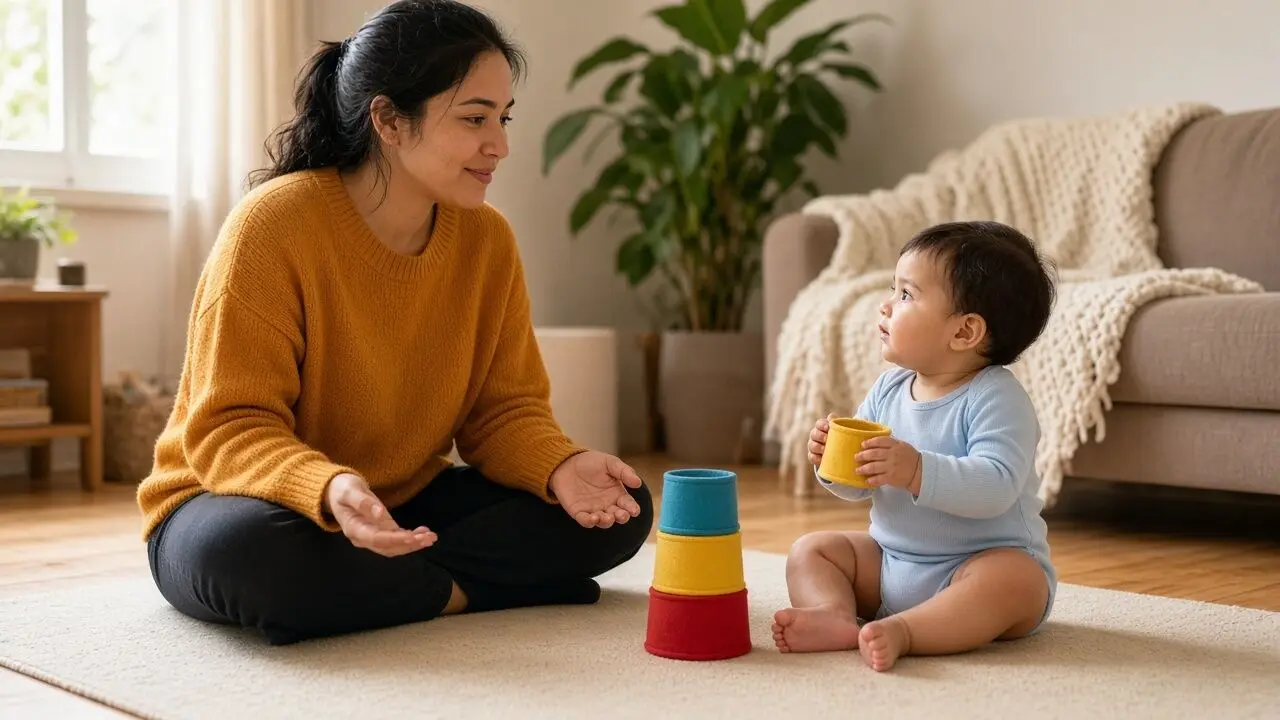
- Give a few minutes of face-to-face play. Of all its measurements, the team chose to film free play between the baby and their caregiver. Sit in front of your baby, at their level, with simple objects such as cups, a wooden spoon or colorful lids. Follow what interests them, copy their gestures and wait for their response before offering something new.
- Care for the caregiver too. PROGRESS measures parents’ anxiety and mood because receiving information about development, with no visible signs, can bring stress or constant watchfulness. If something worries you, talk to the health team that knows your family, and give yourself permission to enjoy your time together without turning every game into an exam.
The next step: meet your child at their developmental stage with TAEO | EdTech
This protocol captures an idea that guides our approach: the same genetic variant can lead down different paths, and the first differences show up in the senses, in movement and in connecting with others. No label, on its own, tells you what that journey looks like. That is why TAEO | EdTech does not start from a diagnosis but from what your child already does. The Skills and Competencies Profile places their developmental level across the eight aspects of neurodevelopment and, from there, the platform orders daily activities tailored to them, the same with or without a diagnosis.
The study also bets on something we share: that no family should go through those first years alone. No app changes a genetic variant; what we can offer you is clear guidance to support your child exactly where they are, with activities that fit into everyday routines.
At the TAEO Psychoeducational Organization we have poured more than sixteen years of experience into TAEO | EdTech so that every family has clear activities and a human team that guides them step by step.
For our official launch in December 2026, you can request an invitation for the free trial using the form below.