Letters that mean something: what a Brazilian review reveals about autism and the path to reading and writing
A team at the Federal University of Santa Catarina gathered the research on how autistic people learn to read and write. Here is what they found, what they cannot claim yet and what to take home.
One afternoon your child sits in front of a school notebook and the letters seem to say nothing to him; a week later, he spots the name of his favorite cereal on the box without any help. For many families of autistic children, reading and writing raise a lot of questions: when will it come, and how can I support it without pushing? A Brazilian team gathered what science has published on the subject, and its conclusion fits in one sentence: the research is scarce, but it agrees that children learn best with pictures, with a purpose and with an adult who acts as a bridge.
What they studied
Lucineide de Araújo Rosa, Márcio Roberto Almeida Pina and Ana Paula de Oliveira Santana, from the Federal University of Santa Catarina (Florianópolis, Brazil), wrote a narrative review that Revista Psicopedagogia published in 2026 after peer review. This kind of review describes, organizes and interprets what has been published on a topic; unlike a systematic review, it does not follow a fixed protocol or pool numbers across studies.
The team searched two academic databases, SciELO and Web of Science, plus the Brazilian Digital Library of Theses and Dissertations, with no date limit. They were looking for work on autistic people that approached reading and writing from education, literacy teaching or speech and language sciences. Of 654 initial records, 78 remained after screening titles; after removing duplicates and reading abstracts they reached 14, and only six met every criterion. Studies of autism together with another condition, and those dealing only with school inclusion, were left out.
The final set is small and varied: three studies with small groups, a doctoral thesis that followed a single child, a master’s dissertation reviewing the literature and a theoretical essay. They come from psychology (three), education, speech and language sciences and linguistics, and none is older than 2016.
What they found
The teaching experiences offer concrete data:
- Syllables and drawings. Gomes and Souza (2016) worked with three boys who could not read yet and who needed level 2 and level 3 support. They taught them in three steps: first, repeating syllables aloud along with words built from them; then recognizing the same word written in different fonts and formats; finally, naming drawings. Performance varied by task, but all three made clear progress and reached reading with comprehension.
- Families inside the game. Menotti and colleagues (2019) brought together three children, two boys and a girl, along with their parents. Using games designed for the study and a computer program, they taught fifteen two-syllable words, and the parents learned to use those materials with their children. All three acquired basic reading and carried it over to words they had not practiced.
- Decoding is not the same as understanding. Ribeiro and colleagues (2021) observed eight autistic boys who could already read and attended mainstream schools, without teaching them anything. In word recognition and fluency, the most frequent result was within the average range; in text comprehension, by contrast, below-average results were more common.
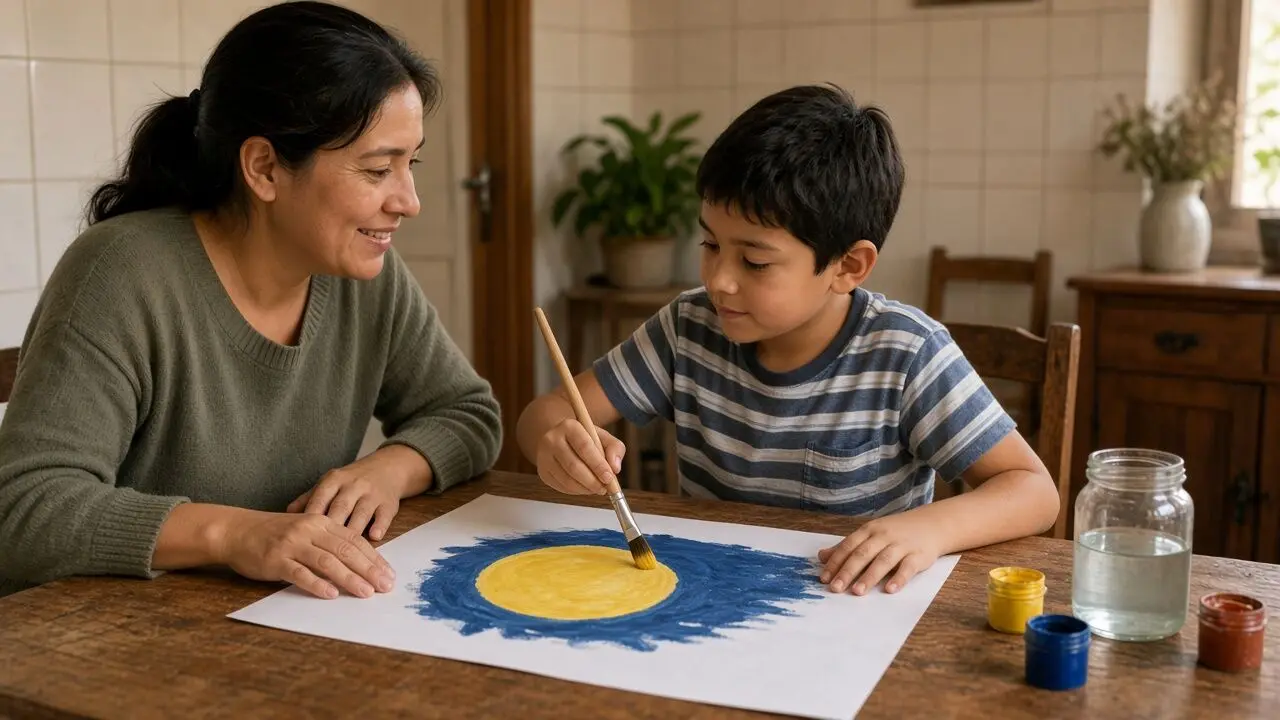
- The Moon, from the sky to the screen. In her doctoral thesis, Silva (2021) supported a third grader through several modules on a single topic, the Moon. First they looked at the sky and talked about it; then they explored news stories and memes about it on the computer, with videos and games to recognize words; later he named it in writing, and finally he painted it with a brush and wrote a short text on the computer with his teacher. The experience clearly strengthened his writing.
The other two works complete the picture. Golinelli (2022) reviewed the literature from education (60%) and speech and language sciences (40%): 80% of it sees writing as something built in relationship with other people, and 20% takes a biomedical view. Among speech and language services, only one study involved families. The essay by Ney and Hubner (2022) reviews well-known approaches for supporting autistic people (TEACCH, ABA and PECS) and notes that none of them explains how to teach reading and writing.
Comparing the proposals, the Santa Catarina team highlights that every one of them used pictures, on paper or on screen, and that the three teaching experiences all reported progress. Two focused on isolated syllables and words, far from real use; the Moon project, instead, started from meaningful texts and an adult’s mediation. The team also points out a gap: the only study that measured reading used tools designed for neurotypical readers, and none considered what is read and written in everyday family life. Its conclusion is that individualized approaches are needed, adapting materials to each person and building on strengths rather than focusing on what is hard.
What we still don’t know
The authors acknowledge important limits:
- Six works are very few, and the studies with participants included between one and eight people each. None of this can be generalized.
- The search covered only a few databases, and the selection criteria may introduce bias. Another review with more sources, cited by the team, also found no more than five relevant articles.
- Autism research has concentrated on spoken language; writing remains underexplored, and no studies looked at how children and teenagers who already read and write actually write.
- The spectrum is very diverse, and what helps one person may not help another. Available resources also vary greatly from one region to another.
- The review reflects what was published up to October 2023, although it appeared in 2026: newer evidence may exist.
We add an editorial note: as a narrative review, it did not rate the strength of each study or combine their results, so its conclusions offer guidance but cannot tell us how well each method works.
What we can take home
None of these ideas require special materials:
- Let letters live in your routine. The authors note that family reading and writing practices, even before formal schooling, support later literacy. Reading a picture book together, writing the shopping list in front of your child or putting his name on a drawing are all ways of bringing him closer to the written word.
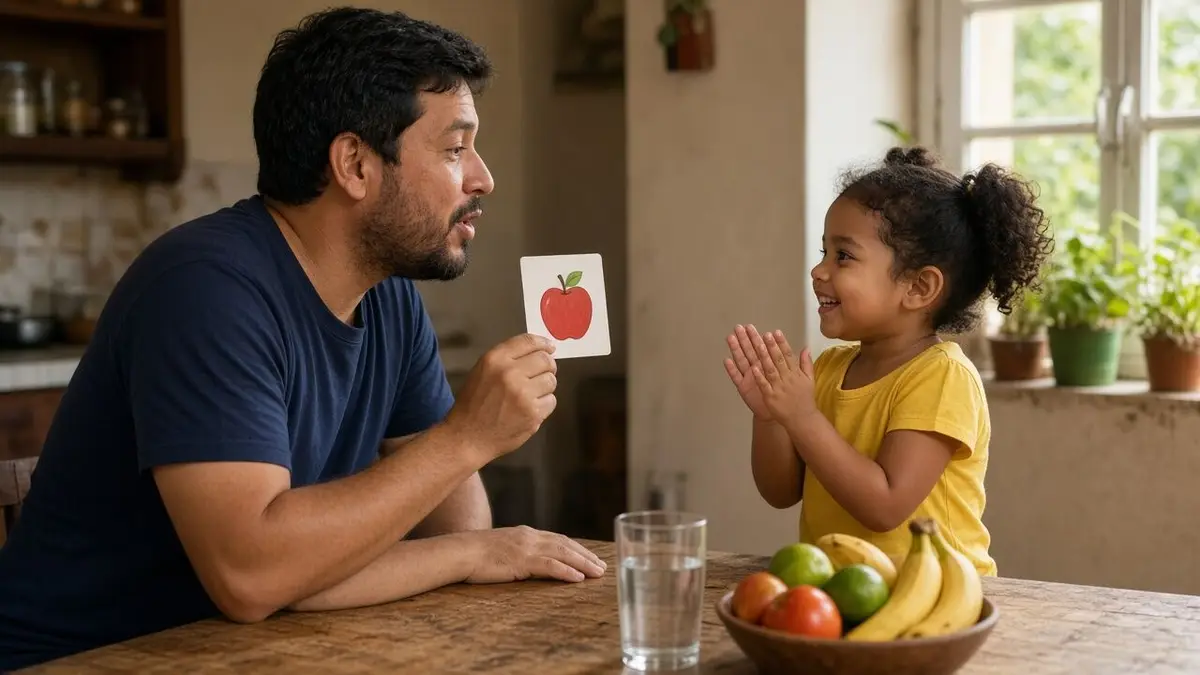
- Pictures as a bridge. Every proposal used visual support. You can stick a photo next to the word on drawers (“socks”, “toys”) or play at matching picture cards with their names. And after a story, rather than asking him to read it fluently, talk about what happened: understanding is a separate skill from decoding.
- A favorite topic, explored in many ways. As with the Moon, choose something he loves and go through it with all the senses: look at it, talk about it, draw it, find its name and, when he is ready, write it. Interest gives every letter a meaning.
The next step: meet your child at their developmental stage with TAEO | EdTech
This review confirms something that guides our approach: the written word is not learned in a vacuum, but alongside an adult who mediates, with pictures and with activities that have a purpose. It also shows that every path is different: some children recognize words fluently and still need support to understand a text, while others reach letters later and by another route. That is why TAEO | EdTech does not start from a label or from age.
The Skills and Competencies Profile covers the eight aspects of neurodevelopment, including communication and language, and shows what your child already does. From there, the platform organizes activities with visual support and clear steps, matched to their real level, so you can share them in everyday moments. The activities are the same for every family; what changes is the path.
At the TAEO Psychoeducational Organization, we have poured more than sixteen years of experience into TAEO | EdTech so that every family has clear activities and a human team guiding them step by step.
To celebrate our official launch in December 2026, you can request an invitation to the free trial using the form below.