Playing together: what a study of two autistic children reveals about music and connection
A team from Spain and Portugal followed an autistic boy and girl through eight sessions of improvised music. Here is what it found, what it cannot claim yet and what to take home.
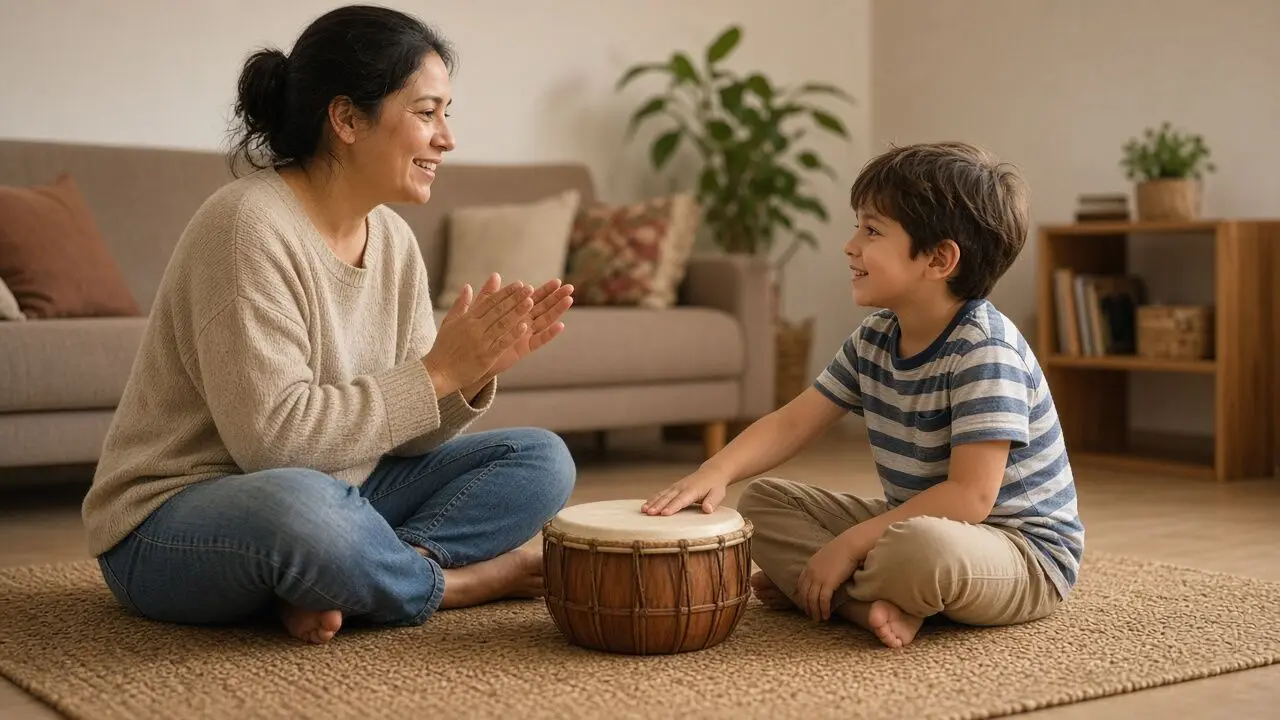
A spoon tapping on the table, a hum while brushing teeth, a clap your child repeats when you start one. Many families find that rhythm opens a door when words have not arrived yet. A study published in August 2026 in the scientific journal Música Hodie took a close look at this in two children and reached a twofold conclusion: the first changes show up in the connection with another person before they show up in speech, and noticing them depends on knowing where to look.
What they studied
A team from the International University of La Rioja (Spain), a psychologist and music therapist, and a researcher from the University of Madeira (Portugal) followed two autistic participants: a five-year-old boy and a six-year-old girl, whose autistic traits the article describes as mild to moderate. Each attended eight individual sessions of 40 to 45 minutes, all recorded on video. The university’s ethics committee approved the project and the families gave written consent.
The sessions followed a steady routine: a hello song, an improvised middle section and a goodbye song. Percussion and simple melodic instruments were used throughout. The adult leading the session followed the child: mirroring the sounds the child made, echoing or extending them, and now and then gently inviting a turn-taking game, like call and response.
To capture what happened, the team compared two tools before and after the eight sessions. The first, the MTCSI scale, looks inside the session at engagement, interaction, moving from one activity to the next and emotional expression. The second, the CARS, is one of the most widely used scales in the world: it scores fifteen areas of behavior and gives an overall total reflecting how marked a child’s autistic traits are. The goal was to describe what changed for each child and to see which of the two tools picked it up better.
What they found
On the session scale, both children made progress. The boy went from 24 to 31 points (29% higher): he improved in interaction (from 8 to 10), engagement and emotional expression, and above all in transitions, which doubled (from 1 to 2). According to the authors, he began to move between activities smoothly, without signs of distress, and to start more musical gestures on his own.
The girl rose from 21 to 26 (24% higher). Her biggest gain was in interaction, up 40% (from 5 to 7): more back-and-forth turns appeared while they improvised. She also gained in engagement, while emotional expression and transitions stayed the same; the team suggests those areas may need more time.
Neither child showed a change in spoken back-and-forth conversation. The authors see this as developmentally expected: the models they cite hold that engagement, emotional regulation and reciprocity are foundations that come before intentional communication and functional language, so words can be expected to take longer.
The overall scale was more conservative. Both children dropped one and a half points on a total that runs from 15 to 60 (he went from 32 to 30.5; she from 35.5 to 34). For the boy, the improvement was concentrated in speech and in adapting to new situations, and he stayed in the same range; for the girl it was spread across a few areas, such as emotional response, nonverbal communication and reactions to what she sees and hears, while most stayed the same.
Taken together: the session scale recorded clear gains in engagement and interaction that the overall total barely reflected. Each tool looks at a different layer: one at the quality of the connection, the other at a broad, stable profile that moves slowly.
What we still don’t know
The article itself lists its limits:
- There were only two children and no comparison group, so it cannot be claimed that the music caused the gains, nor can they be separated from natural maturation or other influences in the children’s lives.
- Eight sessions is a short time; more stable areas, such as language or the overall profile, may need longer periods.
- Measurements were taken only at the start and the end, with no follow-up, so it is unknown whether the gains last.
- The session scale observes what happens with the music therapist, not whether it carries over to home, school or play with other people.
That is why the authors present their results as descriptive and exploratory: useful for generating hypotheses, not for proving effectiveness. They call for longer studies with more participants that include the perspective of parents and teachers.
What we can take home
You do not need to be a musician or buy anything special. The study points to three ideas for everyday routines:
- Follow before you lead. In the sessions, the adult mirrored the child’s sounds and handed them back, sometimes with a small variation. At home, a spoon on a pot, a few claps or a hum will do: if your child taps the table twice, tap twice back and wait.
- A beginning and an end your child recognizes. Each session opened and closed with the same song, a structure that offered predictability while leaving room for the child’s initiative. A short tune to start bath time or to tidy up toys helps your child anticipate what comes next and move from one activity to another.
- Call and response. The girl in the study took more turns while improvising. An echo game works just as well in the kitchen: you play a rhythm, your child plays it back, then you swap roles. Also notice what happens between the two of you (a look, a smile, a pause), even before there are words: according to this study, that is where the first progress shows.
The next step: meet your child at their developmental stage with TAEO | EdTech
Small as it is, this study illustrates something that guides our approach: connection comes before words. Engagement, turn-taking and emotional regulation are built in shared moments, and that is why at TAEO | EdTech you are the one who lives each activity: you sing, play and practice with your child, in the flow of their everyday life.
It also shows that every person moves forward in their own way: with the same sessions, the boy gained in transitions and the girl in interaction. So we do not start from a label or from age. The Skills and Competencies Profile covers the eight aspects of neurodevelopment, including communication and socioemotional development, and shows what your child already does. From there, the platform orders activities matched to their real developmental level. They are the same for every family; what changes is the path. No app promises to move a score; what we can offer is daily support so that those moments of connection become more frequent and easier.
At the TAEO Psychoeducational Organization we have poured more than sixteen years of experience into TAEO | EdTech so that every family has clear activities and a human team that guides them step by step.
For our official launch in December 2026, you can request an invitation for the free trial using the form below.