Listening to autistic people: what a Brazilian review reveals about the voices of the spectrum
Three Brazilian researchers reviewed 33 studies on how families, schools and health teams talk about autism. Here is what they found, what they cannot claim yet, and what to take home.
When a family learns that their child is autistic, opinions start arriving from everywhere: the health team, the school, relatives, neighbors. Everyone has something to say about autism, yet the person living it is rarely heard. A review published this year in Revista Psicopedagogia put a name to that imbalance: in the last decade of Brazilian research, autistic people are among the least listened to, and the views of those around them shift once they share daily life.
What they studied
Three researchers from two campuses of the Pontifícia Universidade Católica, in Rio de Janeiro (PUC-Rio) and Rio Grande do Sul (PUC-RS), carried out a systematic review. They searched five databases (SciELO, BVS, LILACS, PePSIC and Periódicos CAPES) for work published in Brazil between 2013 and 2023, in Portuguese or English. They started in 2013 because that year the DSM-5 manual changed the official name of the spectrum.
Out of 1,746 records, after removing duplicates and texts in other languages, they kept only psychology papers based on their own data that captured what participants think about autism. That left 33 articles: 31 qualitative studies built on interviews and personal accounts, plus two case studies.
To analyze them, they used social representations theory, developed by psychologist Serge Moscovici. It describes how a group makes sense of something unfamiliar: first by linking it to categories it already knows and giving it a name, then by turning it into a concrete image. This lens shows which ideas about autism circulate in homes, classrooms and health services, and how they change.
What they found
The authors grouped the 33 articles by who was speaking:
- Families: 19. Mothers, fathers, siblings and other relatives. By far the most studied group.
- Education: 9. Teachers, mostly women, sometimes alongside parents.
- Health: 2. Professionals and students in health-related degrees.
- Autistic people: 2. Only two studies relied solely on their own accounts.
- Young children: 1. Four- and five-year-olds who shared a class with an autistic girl.
Within families, mothers were the main voices: they usually carry most of the caregiving, often without a support network. No study focused on fathers alone, and other relatives barely appeared (a single grandmother in one sample). Several mothers said that, at first, professionals did not take their concerns seriously and that some relatives drifted away.
The central finding is that the way people understand autism is not fixed: it changes through shared life.
- At home. In some studies autism was framed as an illness; one father said, “whoever finds the disease finds the cure.” The authors push back clearly: there is nothing to cure in something that is not a disease, because autism is a different way of neurodevelopment. More recent studies, by contrast, show families experiencing the news with less sense of grief; having a name for it helped them look for concrete ways to support their child.
- At school. For many teachers, the autistic student was at first “like a foreigner,” in one parent’s words: someone nobody knows how to talk to. Their university training had covered the topic only briefly. Through daily contact, they and the rest of the class came to trust the student’s ability to learn.
- Among young children. Those four- and five-year-olds first linked the autistic girl in their class to “a baby,” perhaps because of how the adult in the room referred to her. Over time, they began to notice what she could do and to expect her to keep growing.
- In health teams. Their views depended on how up to date they were: some were outdated, others recognized each person’s abilities. How a diagnosis is shared shapes how parents will later see their child, and medical and nursing students admitted they had received little information about autism during their studies.
- In their own words. Autistic people describe themselves as capable and ask for respect for their individuality and rights. To avoid being seen as “weird” or “unfriendly,” many hide who they are. A 17-year-old put it this way: “We learn to imitate people so we can fit in,” adding, “performing normality is not being normal.” This effort, known as masking, is linked over time to anxiety, depression and even a higher risk of suicide, according to the research the review cites.
Taken together, the authors conclude that people who live closely with autistic people replace old beliefs with more accurate and respectful ones, and that views are contagious: professionals influence families, and adults influence children. That is why they suggest ableism, the prejudice that measures people by what they supposedly cannot do, may be structural.
What we still don’t know
The review acknowledges its limits:
- Only journal articles. Books, theses and dissertations were left out and might add other perspectives.
- Two languages. Brazilian studies published in other languages were not included.
- A moderate number of publications. There are 33 studies, almost all with small groups: between 1 and 339 participants, most with fewer than 25.
- Few autistic voices. With only two studies centered on them, we know little about how autistic people see themselves. That gap is precisely what the article sets out to highlight.
The authors declare no conflicts of interest.
What we can take home
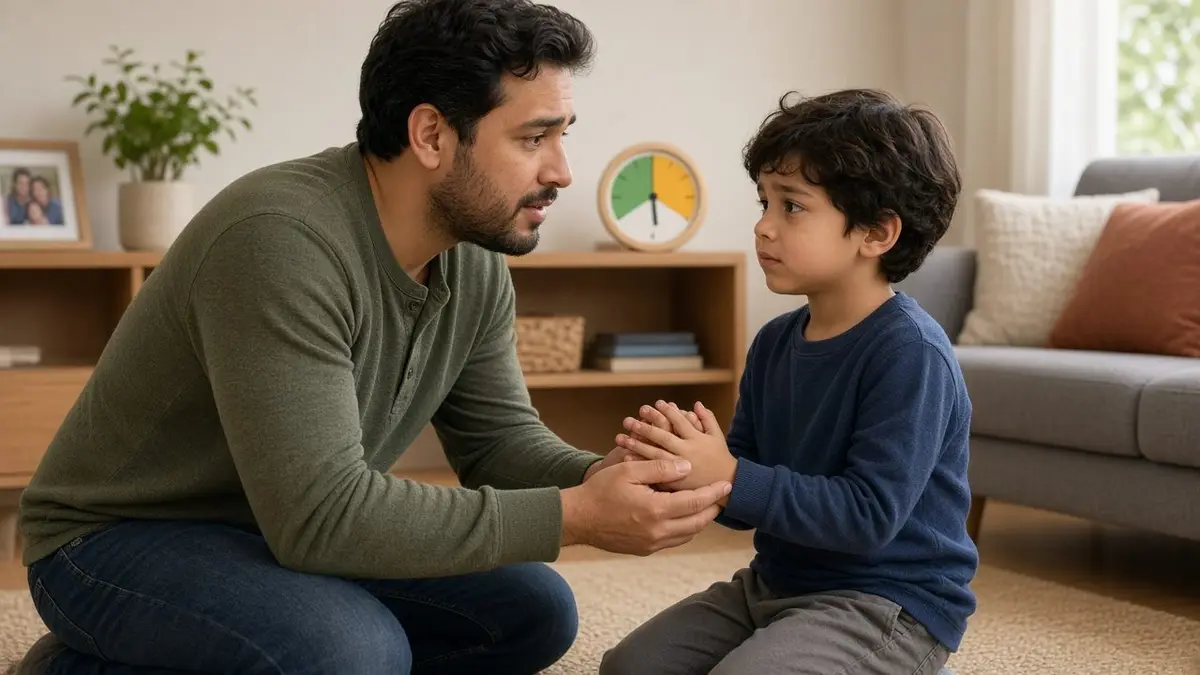
- Ask your child, in their own way. The least heard voices in the review belong to autistic people themselves. At home we can do better: ask what they enjoy, what bothers them or what they need, and accept the answer in whatever form feels comfortable, whether words, gestures, drawings or pointing.
- Mind how you introduce them to others. The image adults convey reaches children. The review notes that expressions like “blue angel” are infantilizing; if we describe them as “a baby,” that is how others will see them. Talking about their interests and what they can already do helps siblings, cousins and neighbors discover the person.
- Leave room for them to be themselves. Masking all day is exhausting. At home, being free to move, shield themselves from noise or talk about favorite topics without being scolded gives them a safe place. If you notice anxiety or sadness that lingers, mention it to their health team.
The next step: meet your child at their developmental stage with TAEO | EdTech
This review leaves two lessons: understanding of autism improves when people get to know the person up close, and no one knows a life better than the one living it. That is why TAEO | EdTech does not start from a label or from age, but from what your child already does. The Skills and Competencies Profile shows their strengths and the areas still in progress across the eight aspects of neurodevelopment. One of them is Socioemotional Development, which covers how a child relates to others and feels accepted. From there, a personal path takes shape: the activities are the same for every family; what changes is the route.
As a psychoeducational tool, it guides the adult who supports the child to practice in everyday life, seeing the child for who they are rather than for a diagnosis.
At the TAEO Psychoeducational Organization, we have poured more than sixteen years of experience into TAEO | EdTech so that every family has clear activities and a human team guiding them step by step.
For our official launch in December 2026, you can request an invitation to the free trial using the form below.