Why table worksheets don't always work: the real power of active learning
Sitting still over a worksheet demands complex motor maturity; understanding how whole-body movement organizes cognition refreshes home learning.
A table is prepared with crayons, workbooks, and tracing sheets. Yet within two minutes, your child is squirming on the chair, dropping supplies, sliding to the rug, or distracted by distant noises. Caregiver concern surfaces quickly: will they keep up in school, or are they struggling with perseverance? Forcing a growing body to sit frozen before a two-dimensional sheet is often the root of resistance, rather than an indication of cognitive difficulty.
The neurodevelopmental perspective
Human learning develops from whole-body movement into abstract thinking, never the reverse. Maintaining pencil grip and visual tracking across lines requires core stability, cervical tone, and integrated vestibular-proprioceptive feedback. For autistic children (ASD) and individuals with dynamic neurotypes, kinesthetic motion is not an avoidance mechanism: it is an organic drive to maintain cortical alertness. When seated stillness is enforced before stabilizing these psychomotor milestones, energy is burned simply staying upright, leaving few resources for higher-order learning.
Practical steps to try at home today
Your home living space offers powerful alternatives to cultivate pre-academic growth through active play:
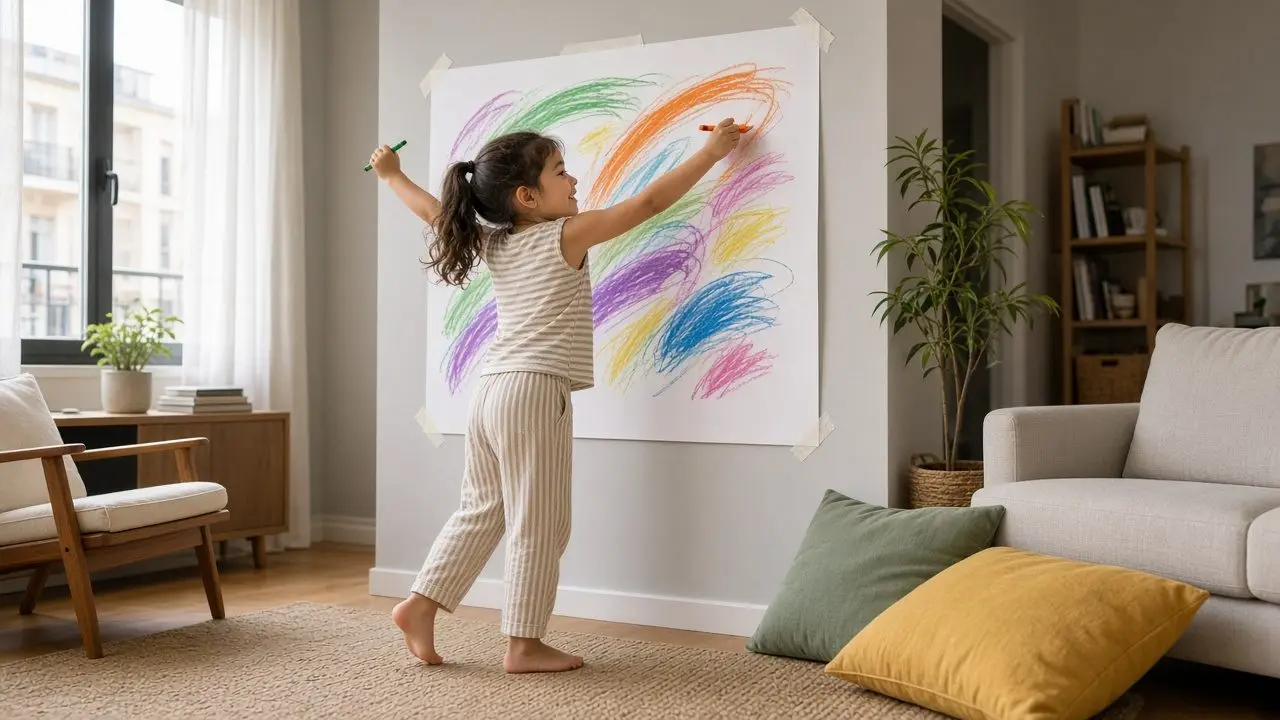
- Draw across vertical planes: Mount large butcher paper onto a wall or use washable bath foam on bathroom mirrors for expansive strokes. Standing activates shoulder girdles and wrist extension naturally.
- Design multi-step obstacle challenges: Create an indoor course with floor cushions to leap across and masking tape balance beams. Place a sorting basket at the finish line where matching colors or items completes the sequence.
- Encourage flexible body positioning: Allow your child to engage in picture books lying on their stomach (prone on elbows), strengthening spinal extensors, or resting on an exercise ball that welcomes ongoing postural adjustments.
The next step: meet your child at their developmental stage with TAEO | EdTech
Effective learning blends sensory action and intellect: Psychomotor and Cognitive domains progress hand in hand throughout human growth. Clarifying where your child currently thrives prevents developmental mismatch and restores motivation.
At the TAEO Psychoeducational Organization, sixteen years of multidisciplinary practice have been distilled into TAEO | EdTech. Through the Skills and Competencies Profile, you identify foundational neuromotor milestones and receive brief, playful routines designed for living rooms and backyards.
Ahead of our official launch in December 2026, claim your priority invitation for a free trial of TAEO | EdTech. Share your email in the form below to join early access and transform everyday movement into meaningful learning.