Brains in sync: what twenty studies reveal about autism and the connection between two people
A systematic review gathered the research that records the brain activity of two people at the same time while they interact. Here is what it found about autism, why the relationship changes the result and what it cannot claim yet.
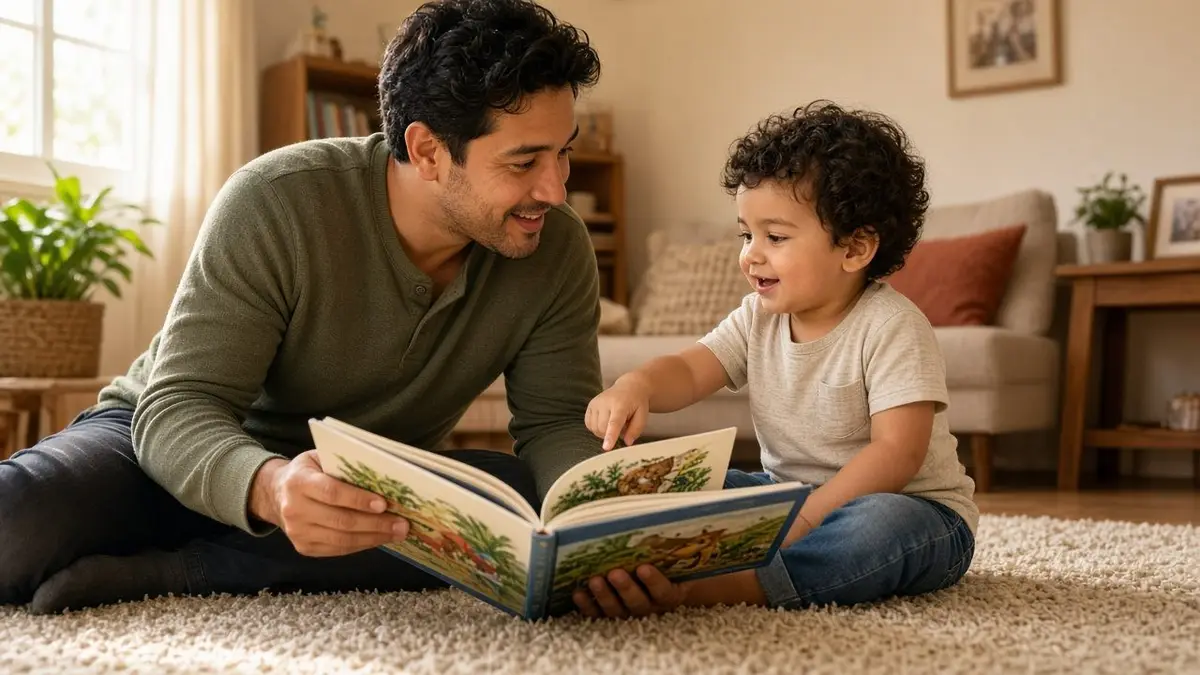
Every parent has lived it: some afternoons, play with your child flows on its own and each of you anticipates the other’s next move; on others, it is hard to find the rhythm. That feeling of being “on the same wavelength” leaves a trace in the brain, and for a little over a decade science has been able to record it. A review published in 2026 gathered everything researched about that attunement when one of the two people is autistic, and its conclusion nuances the usual view: the connection depends as much on the task and the relationship as on the individuals taking part.
What they studied
The technique is called hyperscanning: it measures the brain activity of two people at the same time while they talk, imitate each other or play together. This makes it possible to calculate how closely both brains fall into step, what researchers call interpersonal neural synchrony. Almost all the studies used infrared light sensors placed on the head or electroencephalography; one used magnetic resonance imaging and another magnetoencephalography.
A team from Massachusetts General Hospital and Harvard Medical School (United States) and the universities of Gothenburg (Sweden) and Montreal (Canada) searched scientific databases and preprint repositories, with an update in April 2025. Out of 1,552 records, only 20 studies met the criteria: 15 included autistic people and 5 measured autistic traits in neurotypical people, because those traits are spread in degrees across the whole population. Two reviewers independently rated the quality of each one: 10 were good, 4 in between and 6 fair.
Participants ranged from early childhood to adulthood, and the situations were very different: chatting face to face, looking into each other’s eyes, imitating hand movements, reading a story or cooperating in a video game. The pairs varied too: a mother or father with their child, two classmates, two strangers.
What they found
Of the 16 analyses that actually calculated synchrony between two brains, 14 found it was lower when one of the people was autistic or had marked autistic traits (in three, only in certain situations). One found no difference and another observed the opposite. Three studies also showed a gradual relationship: the more autistic traits, the less synchrony, with no sharp cut-off between groups.
The most revealing part lies in the exceptions, because they show what that connection depends on:
- The relationship matters. Between mothers or fathers and their children, the differences were small or absent; between strangers, they were more noticeable. In one study, the parents of autistic children relied more on waiting before acting during a cooperative game, and that strategy was linked to greater synchrony in all families. The authors interpret it as scaffolding: the person who knows the other well holds up part of the encounter.
- So does the purpose of the task. When imitating movements with a clear goal, autistic participants reached more synchrony than their neurotypical peers; with meaningless gestures it was the other way round. When the goal is transparent and each person knows their role, the gap shrinks or disappears.
- Being alike helps. In a study with university students, pairs in which both had many autistic traits showed the highest synchrony and enjoyed the conversation the most. Another study did not confirm this, and there all pairs rated the conversation the same. For the authors, how the interaction is experienced could play a role, which fits the idea of “double empathy”: misunderstandings arise between two different ways of processing the world, not from one side alone.
The review’s conclusion: lower synchrony is a consistent finding, but it is tied to context. It reflects how hard it can be to build shared attention and expectations, not a fixed shortcoming.
What we still don’t know
The article itself lists its limits, and they are worth keeping in mind:
- The studies measured things in such different ways that their figures could not be combined in a meta-analysis, so the true size of the effect is unknown.
- Samples were small (a median of 17 autistic participants), recruited by convenience, mostly male, and did not include autistic people with intellectual disability.
- Everything was recorded in a laboratory or clinic, and half the studies used on-screen interactions, which reduce synchrony on their own.
- Each study observed a single moment: it is not known whether lower synchrony is a cause, a consequence or an adaptation.
- No team pre-registered its analyses, several ran many comparisons without proper statistical correction, and the certainty of the evidence is moderate at best. Five conclusions, including those about similar pairs and purposeful imitation, rest on one or two studies and are provisional.
Nor is it a tool for identifying autism today: the first attempts were right between 70% and 78% of the time, and the authors stress that its practical usefulness has yet to be shown.
What we can take home
Although these studies were done with sensors, they leave ideas that work in daily life:
- Relationship first. The review suggests that familiarity sustains connection. Your voice, your presence and your shared routines are already a bridge; before proposing something new, set aside a few minutes of play in which your child sets the pace and you follow.
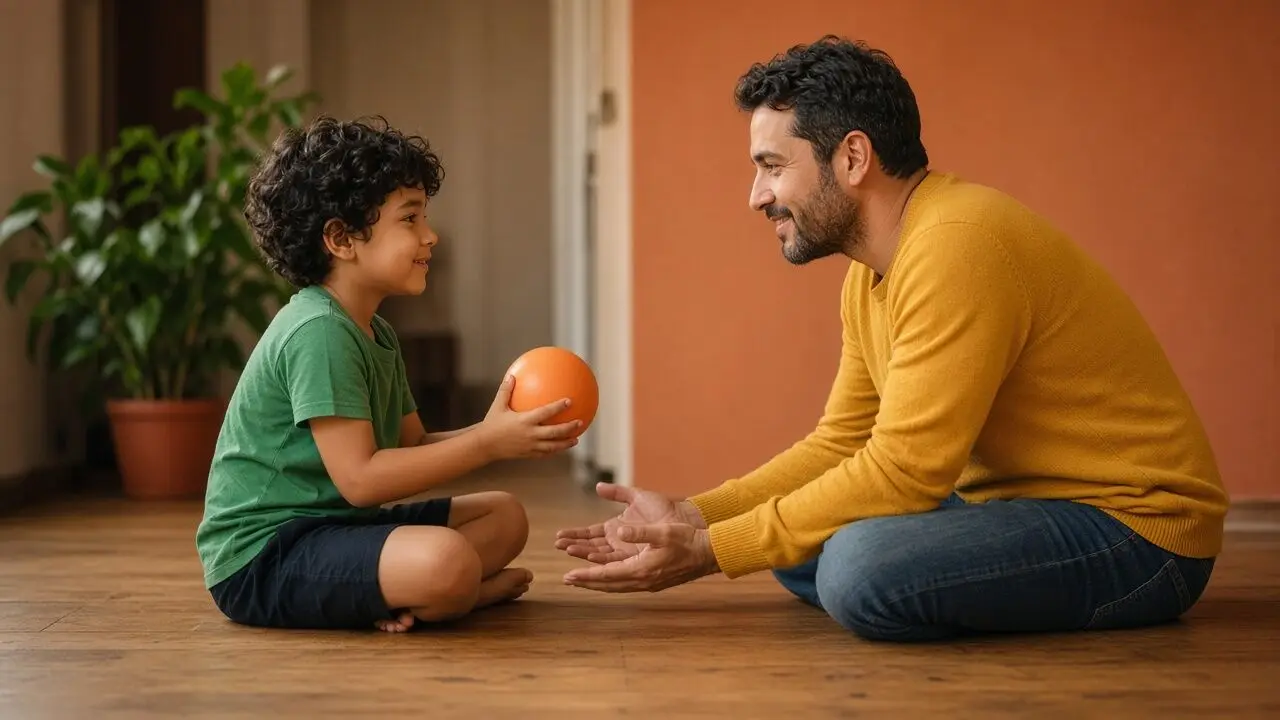
- Clear goals and defined turns. When an activity has a visible purpose, synchrony improves. Instead of “let’s play”, offer something concrete: “I throw the ball, you catch it, then we switch”. Showing when it ends (“when the tower reaches here, we put it away”) helps them anticipate.
- Waiting also communicates. Leaving a few seconds of silence before answering or giving the next instruction gives your child time to process and join the exchange. That pause is part of the adult half of the conversation.
The next step: meet your child at their developmental stage with TAEO | EdTech
This review confirms something that guides our approach: communication does not happen inside a single head but between two people, and it depends on the relationship, on the meaning of what is being done and on how much each adjusts to the other. That is why at TAEO | EdTech you are the one who lives each activity: you play, talk and practice with your child, in the moments of their routine.
The findings also show that every person is different: the same child falls into step one way with one task and another way with the next. So we do not start from a label or from age. The Skills and Competencies Profile covers the eight aspects of neurodevelopment, including socioemotional development and communication, and shows what your child already does. From there, the platform orders activities with clear goals and defined steps, matched to their real developmental level. They are the same for every family; what changes is the path. No app measures the synchrony between two brains; what we can offer is daily support so that those encounters become more frequent and easier.
At the TAEO Psychoeducational Organization we have poured more than sixteen years of experience into TAEO | EdTech so that every family has clear activities and a human team that guides them step by step.
For our official launch in December 2026, you can request an invitation for the free trial using the form below.